
What Global Conflicts Mean for Your Investments
Recent headlines about military strikes involving the United States, Israel, and Iran have understandably raised concerns for investors. When geopolitical events escalate quickly, it is natural to wonder what this means for the economy, oil prices, and your portfolio.
The reality is that markets have faced events like this many times before. Wars, regional conflicts, political instability, and economic shocks have occurred throughout modern market history. Yet despite short-term volatility, long-term investors who stayed disciplined have historically been rewarded.
Let’s put the current situation into perspective.
Why the Middle East Matters to Markets
The primary economic channel through which Middle East conflicts affect financial markets is energy prices.
Iran produces roughly 3 million barrels of oil per day and sits along the Strait of Hormuz, the most important energy shipping route in the world. Roughly 1/3 of global seaborne oil and about 1/5 of natural gas exports pass through this waterway. Any threat to this route can cause oil prices to rise quickly.
In response to the recent escalation:
Oil prices moved into the low $70 range for West Texas Intermediate (WTI) and just under $80 for Brent crude
Energy markets reacted quickly to potential supply disruptions
Investors began reassessing the risk of broader regional conflict
However, it is important to keep this in context.
Oil prices remain well below the nearly $128 per barrel peak reached in 2022 following Russia’s invasion of Ukraine. The United States also produces more oil and natural gas today than any other country, which helps buffer the domestic economy from supply shocks.
In short, while energy prices can move quickly in response to geopolitical events, the long-term economic impact is often smaller than the headlines suggest.
Markets Have Seen This Before
History shows that geopolitical crises often cause short-term market swings, but they rarely change long-term market trends.
Global markets have navigated:
World War II
The Korean War
The Gulf War
The wars in Iraq and Afghanistan
Russia’s invasion of Ukraine
The Israel–Hamas conflict
Each of these events created uncertainty, but the long-term direction of markets continued to follow economic growth, innovation, and corporate earnings rather than geopolitical headlines.
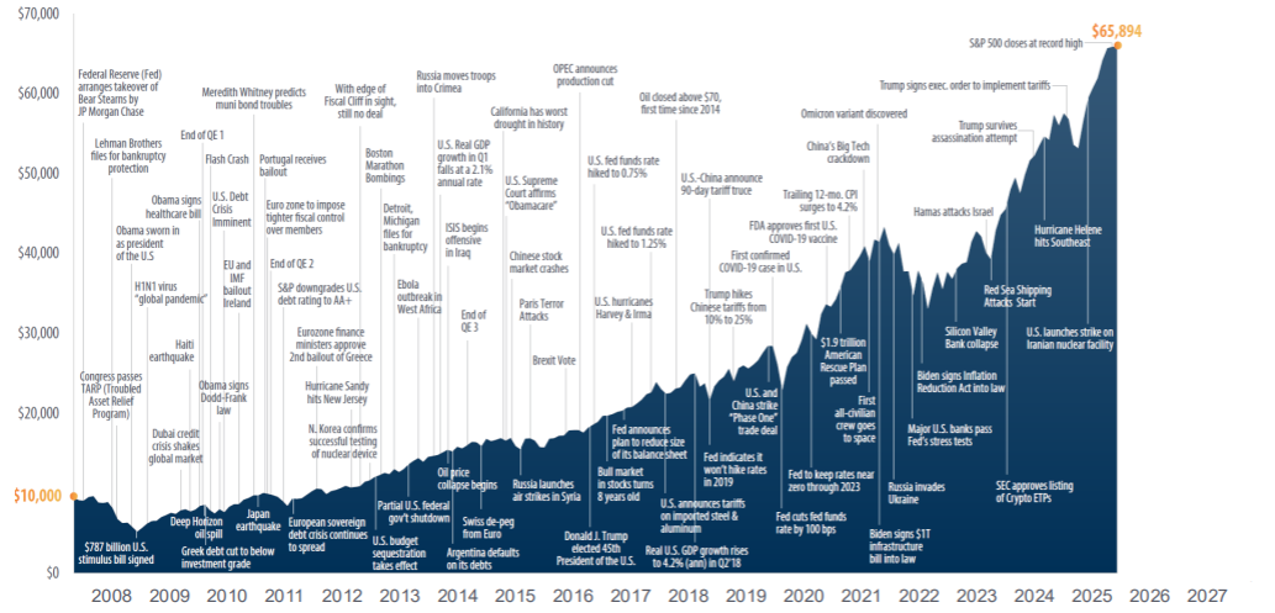
This pattern explains why disciplined investors often benefit from maintaining their strategy rather than reacting emotionally to news cycles.
The Hidden Cost of Trying to Time the Market
One of the biggest risks during periods of uncertainty is getting out of the market at the wrong time.
Historical data from the S&P 500 shows that the strongest market days often occur during periods of stress or shortly after major declines.
The chart below highlights two important points:
50% of the market’s best days occurred during bear markets
Another 28% occurred in the first two months of a bull market recovery
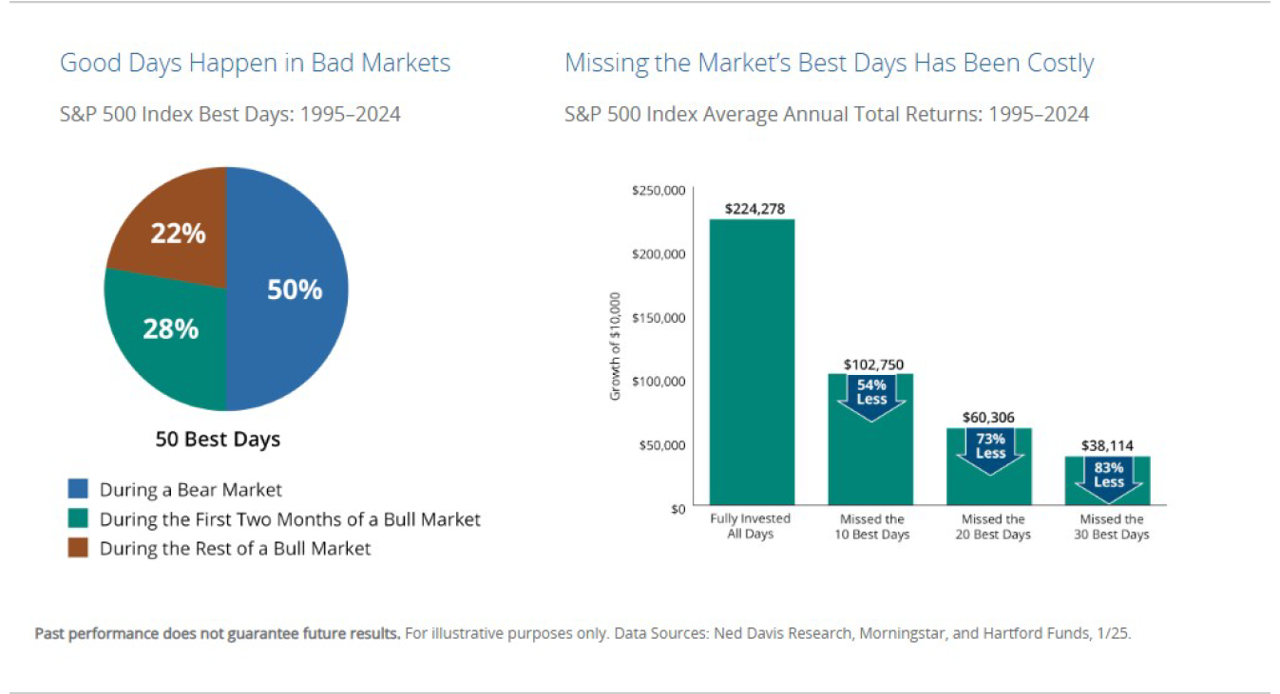
The impact of missing those days is significant. A hypothetical $10,000 investment in the S&P 500 from 1995 through 2024 would have grown to approximately:
$224,278 if fully invested
$102,750 if the 10 best days were missed
$60,306 if the 20 best days were missed
$38,114 if the 30 best days were missed
In other words, missing only a handful of strong market days can dramatically reduce long-term returns. Its more important to have a plan in place on when to take advantage of the downtuns.
Related: The Market Is Down—Now What? Smart Moves to Consider
Final thoughts
The current conflict involving Iran represents a serious geopolitical development and will likely create short-term volatility in energy markets and investor sentiment.
However, history shows that markets are resilient. Over time, economic growth, innovation, and corporate earnings have been far stronger drivers of investment returns than geopolitical events.
The most effective strategy remains the same one that has worked through past wars, recessions, and crises:
Stay disciplined. Stay diversified. Stay invested.
Related: How to Build a Sustainable Retirement Income Plan
Visit my site -> finnprice.com
Education on a Weekly Basis -> Newsletter
Subscribe to the Youtube Channel for more video content -> Finn Price Youtube
About the author: Finn Price, CPFA, CEPA, is a business owner and wealth manager at Railroad Investment Group. He helps successful entrepreneurs & individuals with concentrated stock positions in their 30s, 40s and 50s build, organize, protect and transfer their wealth.
Note: this article is general guidance and education, not advice. Consult your money person or your attorney for financial, tax, and legal advice specific to your situation.
Securities and advisory services offered through LPL Financial, a registered investment Advisor, Member FINRA/SIPC.
